
← About norvillenorville

Slide into Guitar

Sound good while you learn to play guitar.

This is how I’m learning, written up so you can try it too.

I came to guitar from piano, and it’s a whole different way of thinking. On a piano every note has one spot and you can see the whole layout in front of you. On a guitar the same note shows up all over the neck, and your two hands do completely different jobs.

I’ve owned an electric guitar for decades. Mostly it sat there and frustrated me. The baritone ukulele is what finally unlocked it for me. Here’s how.
Guitar fretboard with six strings, E B G D A E from highest to lowest. The top four strings are shaded as the baritone ukulele, tuned E B G D, starting at the nut: the baritone is the guitar’s top four strings. GUITAR BARITONE E B G D A E E B G D 0

The baritone ukulele is the guitar’s top four strings. Same notes, right from the nut. Anything I learn on it already works on a guitar, which is the whole reason I started there.

Borrowing from the Delta

Delta blues players like Son House and Robert Johnson often tuned so the open strings rang out as a chord. It’s called open tuning.

I did the same thing on the baritone, just lowered one string. With one finger I had three chords, which is enough for the blues, and I was playing it the first day.

Taking one piece out

Early on my chord hand was the problem. Every time it fumbled, my strumming stopped too.

So I mostly took chords out of it and let my right hand learn the groove first. I found out later there’s a name for this. It’s called task splitting.

How the learning splits up

This is roughly how it went for me. Where the ribbon’s thick, that hand was doing the work. Where it’s thin, it was either barely doing anything or already on autopilot.

Learning timeline in six stages: open G, blues, back to standard, guitar shapes, a song, then guitar. The instrument goes from 4 strings in open G, to 4 strings in standard, to 6 strings. The right hand does most of the learning in the first two stages and then runs on its own. The left hand does almost nothing at first, then takes over from stage 3 on. 1 Open G 2 Blues 3 Standard 4 Shapes 5 A song Then guitar 4 strings, open G 4 strings, standard 6 strings Right hand Strumming Steady strum,then swing 12-bar groove,slide Same strum,on its own Runs on its own from here Left hand Chords One fingerflat Add thepinky Pinky shape isnow G, C, D Real chordshapes Changesin a song Two morestrings Retune one string Pick up a guitar

Each change made one thing easier. I dropped from six strings to four, and in open G one finger did the job of a chord shape. By the time my left hand had real work to do, I wasn’t thinking about my right hand anymore.

How the tunings line up

Guitar E A D G B E Baritone D G B E Open G D G B D one string lower

To read the chord boxes below, the four up-and-down lines are the strings, lowest on the left. Press where the dots are. A circle on top means play that string open. The little numbers down the side are fret numbers.

Tune to open G and find the groove

First I tuned down. I lowered the highest string, the one closest to the floor, and kept strumming while I turned the peg until the open strings sounded like a chord. That’s G.

That gave me three chords. Each one is just one finger laid flat across the strings.

G
C
D

Then I just strummed, slow and steady at first and then with a swing, like the long-short bounce on old blues records. My only rule was to keep the right hand moving, even if the chord change came in late. If you try this, that’s the one rule I’d hang on to.

Play the blues

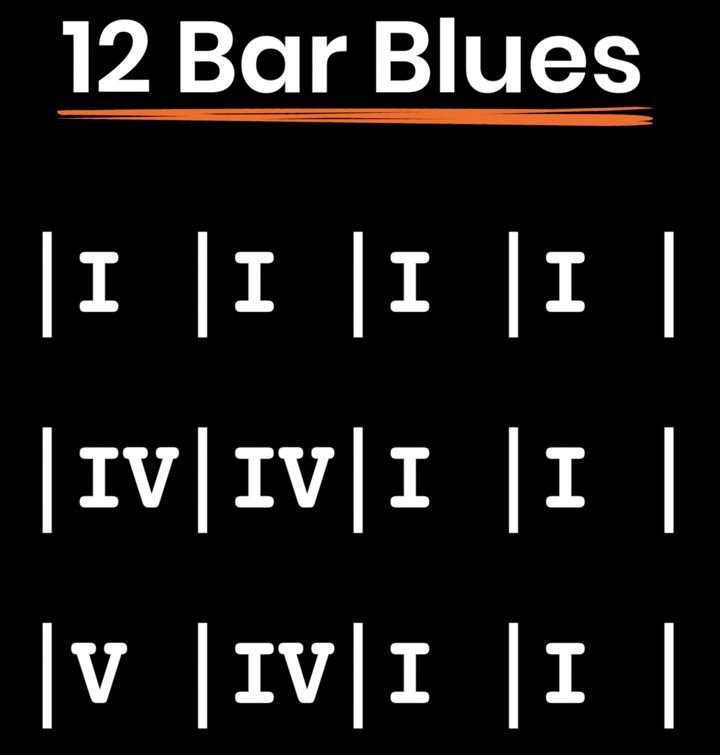
This part was fun. The 12-bar blues uses those same three chords, one per bar. Read it left to right like a page and then go back to the top.

12 bar blues chart. Row one: I, I, I, I. Row two: IV, IV, I, I. Row three: V, IV, I, I.
In open G, I is G, IV is C and V is D.

Once I could get through it without stopping, I tried a slide. You rest a glass bottleneck or a metal tube on the strings right over the fret and don’t press down. It sounds a lot like those old Delta records.

I also started putting my pinky three frets up on the highest string, which makes it sound bluesier. Hang on to that shape, it comes back in step 3.

G7
C7
D7

Tune back to standard

When the strumming felt automatic I tuned that string back up. It should match the B string when you hold the B down at the 5th fret. That’s standard tuning, same as the top four strings on a guitar.

My right hand didn’t really notice. The one-finger chords still sounded fine, a little jazzier. And the pinky shape from step 2 now plays regular G, C and D chords, which my hand already knew how to do.

G
C
D

Learn the guitar shapes

This is where my left hand finally had to work. These are guitar chord shapes, just the top four strings. I did G, C and D first, then the others, and played the 12-bar with them.

Something that tripped me up was my tuner app. It kept showing regular ukulele chords even with baritone selected. Guitar chord charts work fine, you just ignore the two low strings.

G
C
D
Em
Am
D7

Learn a simple song you like

Next I wanted an actual song, so I went with Johnny Cash. A lot of his songs only use a few chords, and I already knew them.

Pick something you like that only has three or four chords. Look up the guitar chords and play the top four strings of each one.

Next, a guitar.

That electric guitar is finally getting played. I’ve got it in open G because I want to learn slide blues on it. It’s the same four strings I’ve been playing with two lower ones added, so I’m not starting over.

If you want to hear what I’ve been making, here’s my music.

About task splitting

I was doing this before I knew it had a name. Task splitting is when you break a hard skill into pieces and practice one until it runs on its own before you add the next. Researchers usually call it part-task training.

It works best when the pieces come apart easily, and on guitar they do. One hand keeps time and the other makes chords. Open G let me learn the rhythm part first.